
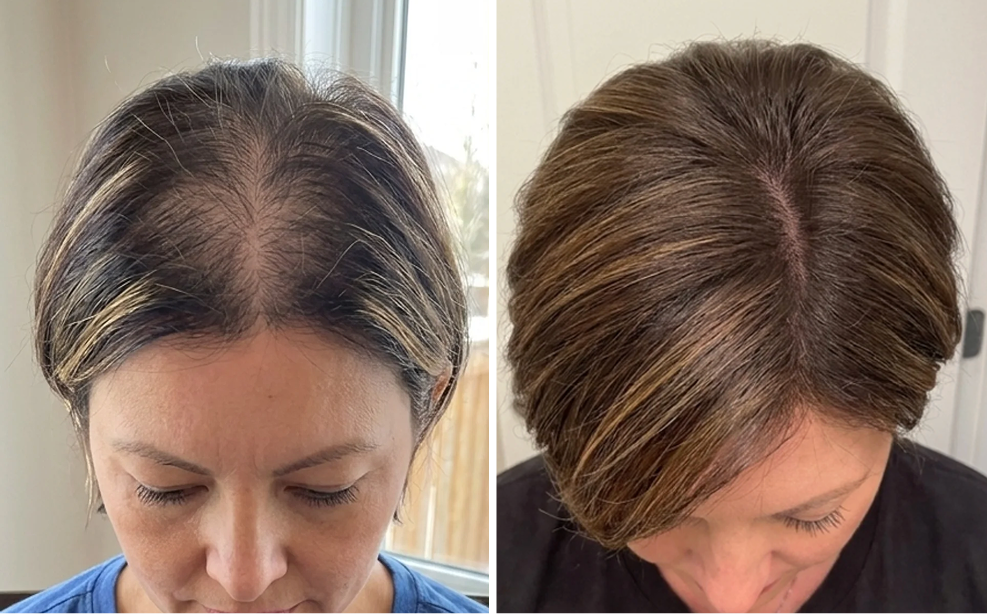
Hair Growth Supplement Clinical Evidence
Hair growth supplement clinical evidence is data from real people who took a supplement for a set period while their hair was measured, usually by counting hairs and checking strand thickness on scalp images. That is the bar this guide uses. It covers what a credible study looks like, which ingredients have support and for whom, and how to check a brand's claims in a few minutes.
Because hair grows in cycles that take months to turn over, the studies worth reading check in at three, six or nine months rather than after 30 days. And because hair loss is not one condition, a result only means something if it matches the kind of thinning you have. Pattern thinning, postpartum shedding, stress-related shedding, low-iron shedding and autoimmune hair loss each behave differently.
 No complicated routine. Two capsules a day for thicker, fuller-looking hair.
Shop
No complicated routine. Two capsules a day for thicker, fuller-looking hair.
Shop
What does hair growth supplement clinical evidence actually mean?
Clinical evidence means data collected in people under defined conditions, as opposed to ingredient theory or customer enthusiasm. It is the difference between saying a formula should help hair and showing what happened when people took it for months.
The category mixes four kinds of proof, and they carry different weight. Customer reviews tell you how people describe their experience, which is useful for setting expectations but is not measurement. Single-group studies follow one group on the product and measure each person against their own starting point. Randomized, placebo-controlled trials split people into a group that takes the product and a group that takes a placebo, which shows how much of the change came from the product itself. Peer-reviewed publication adds outside experts who check the methods before a paper appears in a journal.
What counts as strong evidence in this category?
Three things matter most: objective measurements such as hair counts and strand thickness rather than impressions, a study long enough to cover the hair cycle, and a clearly described group of participants. A placebo group and randomization add the most weight, because they separate the product's effect from everything else going on in people's lives over those months.
A short, loosely described study can still be interesting. It should not carry the same weight as a long one with measured outcomes.
Why hair supplement evidence is often harder to judge than drug evidence
Most hair supplements combine several ingredients, so a study shows what the whole formula did rather than which ingredient did the work. Some brands cite a "clinical study" without saying who took part, for how long, or what was measured. Others stretch a narrow result, such as less shedding in one small subgroup, into a claim about all hair loss. Reading past the front of the bottle is how you tell these apart.
The Root Co. vs Nutrafol vs Vegamour
| Feature | The Root Co. | Nutrafol | Vegamour |
|---|---|---|---|
| Taken as a capsule, nothing to apply | ✓ | ✓ | ✕ |
| Two capsules a day | ✓ | ✕ | ✕ |
| Biotin-free | ✓ | ✓Women Advanced | ✕ |
| Under $50 a month on subscription | ✓ | ✕ | ✓ |
| Start for $49.90/mo |
Compared with Nutrafol Women Advanced and Vegamour GRO Hair Serum.
How researchers evaluate whether a hair growth supplement works
Hair grows in phases: a growth phase that lasts years, a short transition, a resting phase, and then shedding. One full turn of that cycle takes months, so a claim of dramatic regrowth in 30 days runs against the biology.
Studies track several outcomes because they move at different speeds. Shedding can change first. Hair count, density and the width of each strand take longer, while standardized photographs and the participants' own ratings show how the change looks and feels. A good study tells you what changed, when it changed, and how it was measured.
Which trial endpoints are meaningful and which are weak
The strongest endpoints are objective. Phototrichograms and trichoscopy images count hairs in a marked patch of scalp, measurements of the hair shaft track strand width, and standardized photographs taken the same way at every visit show the overall picture.
Satisfaction surveys matter too, because hair loss is visible and emotional, but they belong next to the measurements rather than in place of them. If the only evidence is that most users felt happier with their hair, the claim built on it should stay modest.
How long should a credible hair supplement study run?
Three-month data can show early signals. Six- and nine-month checkpoints show whether those signals turned into measurable change in density and thickness, which is what most people buy a hair supplement for. A 30-day trial tells you about tolerability and little else.
What the clinical evidence says about common hair growth supplement ingredients
Evidence for hair ingredients is strongest when an ingredient corrects a specific shortfall, and weakest when it is sold as a fix for every kind of hair loss.
Ingredients with a plausible role but condition-dependent evidence
Vitamin D, zinc and iron are the clearest examples. All three matter for normal follicle function, and low levels are linked with shedding and thinning in some people. Correcting a real shortfall can support healthier hair cycling, while topping up levels that are already normal may do less. That is why it pays to know your numbers before you pick a formula.
For zinc specifically, our guide to zinc for hair loss covers the research and the daily amounts in detail.
Ingredients that are popular but often overstated
Biotin leads this list. It is the headline ingredient in most hair vitamins, yet biotin deficiency is uncommon, and the clinical support is much stronger in people with a documented deficiency than in the general population of people with thinning hair. High doses can also interfere with some lab tests.
Collagen and other trend-driven add-ons sound convincing because they are familiar, but the support for actual hair growth is usually thinner than the marketing. Marine extracts and botanical blends have stronger data in a few branded formulas, and those results belong to the formula that was tested, not to every product with a similar-looking label.
Why many hair vitamins fail in practice
A lot of hair vitamins fail because they follow what is popular instead of what is driving the thinning. A single-ingredient formula can help in one narrow situation, but hair loss often has more than one driver. Many readers who feel they have tried everything have tried the same idea in different packaging.
How to compare clinical evidence across hair supplement brands
Start with the same questions for every brand, before price and before the ingredient list. Is the formula patented? Are the ingredient forms and doses named? Who took part in the study, and how many people? How long did it run, were the outcomes measured objectively, and was there a control group? Does the brand describe the study in enough detail for you to judge it?
Questions to ask before trusting a brand's clinical claims
Those questions filter out a surprising amount of weak marketing, mostly because weak claims leave them unanswered. Established brands often have a longer evidence trail because they have been around longer. A newer formula earns a look when it answers each question in the open and keeps its claims inside what it measured.
Where The Root Co. fits in an evidence-based comparison
The Root Co. Hair Vitamin is a biotin-free, vegan supplement taken as two capsules a day. It is built around Phyllotex, a patented plant blend, with 15 mg of zinc (136% of the daily value), magnesium and pantothenic acid. Here is how it answers the questions above.
| Question | The Root Co. |
|---|---|
| Is the formula patented? | Yes, US Patent 11,160,750 |
| Are ingredient forms and doses named? | Yes: zinc as zinc picolinate 15 mg, magnesium 85 mg, pantothenic acid 5 mg and the 345 mg Phyllotex blend, per two-capsule serving |
| Who took part? | 38 adults: 22 women aged 25 to 55 and 16 men aged 30 to 50 |
| How long did it run? | Nine months, with scalp images at the start and at four, six and nine months |
| Were the outcomes objective? | Yes, TrichoView scalp imaging measured hair count and Hair Mass Index |
| What changed? | In thinning areas, hair count reached about 2.6 times baseline and Hair Mass Index rose from 15.9 to 50.2 |
| Study design | A 9-month single-group study of 38 adults with no placebo group |
| Is the study described in public? | Yes, in full on our review page |
Plan on three to six months of daily use to judge it on your own hair. The first 90 days are covered by a money-back guarantee.
Realistic expectations: what hair growth supplement clinical evidence can and cannot tell you
Clinical evidence tells you what a supplement did for a defined group over time. It cannot predict exactly how your scalp will respond, because a group result averages people who did better with people who did less well.
Supplements make the most sense for early to moderate thinning and diffuse shedding, including shedding after a stressful stretch or after pregnancy, while the follicles are still active. A supplement is not a diagnosis, so loss that is sudden, patchy or severe deserves a medical look first.
What results are realistic by month 1, month 3, and month 6 plus
In the first month, expect to build the routine rather than see change, because hair grows slowly. Around month three, studies start to pick up early signals. From month six on, density, strand width and overall coverage are easier to judge, which is why the strongest studies keep measuring through month nine.
Many people stop too early, before the biology has had time to show anything.
When to see a dermatologist before trying another supplement
Get a medical evaluation first if you have:
- sudden or severe shedding
- patchy loss
- signs of scarring
- hair loss that started after a medication change
- postpartum shedding you are unsure about
- symptoms that point to a thyroid problem
- risk factors for low ferritin or iron deficiency
- a pattern that suggests an autoimmune cause such as alopecia areata
If you are pregnant, nursing or taking prescription medication, check with your healthcare provider before adding a new supplement.
Daily support for fuller-looking hair
Just 2 capsules a day. Biotin-free and vegan.
In our 9-month study of 38 adults, hair count in thinning areas rose to about 2.6x the starting level. Single group, no placebo. See the study
90-day money-back guarantee · Cancel anytime
FAQ
Do hair growth supplements have real clinical evidence?
Some do. The strongest evidence comes from studies that measure hair objectively, such as hair count and strand thickness, over months rather than weeks, in a clearly described group of people.
What is the strongest clinical evidence for hair growth supplements?
Randomized, placebo-controlled trials that measure hair count, density or thickness over at least three to six months. Publication in a peer-reviewed journal adds another layer of credibility.
How long does it take to see results from a hair growth supplement?
Plan on months, not weeks. Hair grows in cycles that take months to turn over, which is why credible studies check in at three, six and nine months, and why density and thickness are best judged from month six on.
Is biotin actually supported by clinical evidence for hair growth?
Biotin is most clearly supported when a person is biotin-deficient, which is uncommon. For general hair thinning, the evidence is much weaker than the marketing suggests, and that is why biotin alone often disappoints.
How can I tell if a hair supplement study is credible?
Check who took part and how many, how long the study ran, what was measured and how, whether there was a control group, and whether the brand describes the study in enough detail for you to judge it.
Can a hair growth supplement help with hormonal or stress-related shedding?
It can be a reasonable addition for stress-related shedding or postpartum recovery while the follicles are still active, alongside a doctor's check for causes such as low iron or thyroid changes. Sudden, patchy or severe loss should be checked by a doctor first.
These statements have not been evaluated by the Food and Drug Administration. This product is not intended to diagnose, treat, cure, or prevent any disease.
Read more

Why most hair vitamins fail often comes down to mismatch, weak formulas, and unrealistic expectations. Here is what actually matters before you buy.
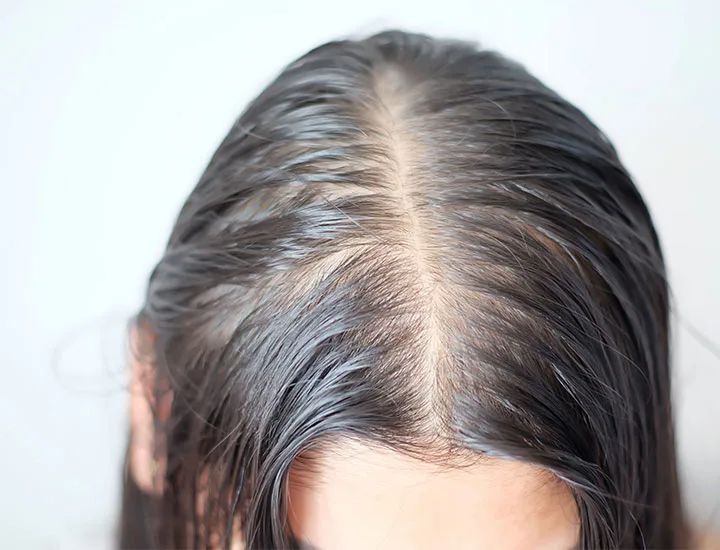
Learn how DHT causes hair loss, why some follicles are sensitive to it, common signs in men and women, and what treatment options may help.