
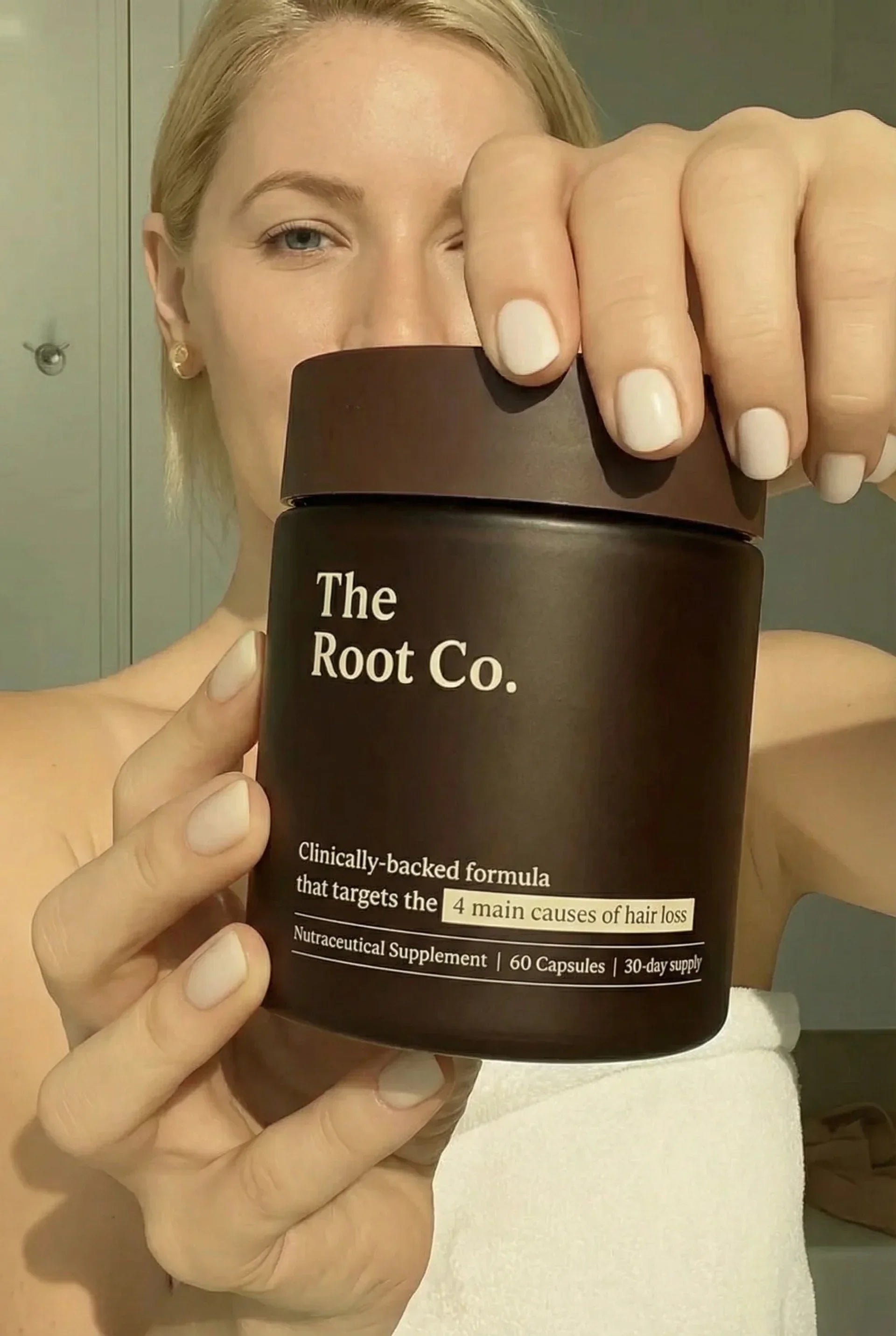
The Root Co. Hair Vitamin Review: Does It Work?

Most hair supplements pick one lever and pull it. The Root Co. Hair Vitamin is built on a different premise: that thinning usually has more than one driver, so a formula should work on more than one at a time. The interesting part is that this claim is not just marketing. The formula has been measured in an independent nine-month study, published in peer-reviewed research (under the name Phyllotex, its clinical brand), and compared with the big names in the category.
This review works through what that evidence actually shows, what is inside each capsule and why, how it stacks up against Nutrafol, Viviscal, and minoxidil, and who should and should not bother with it.
At a glance
The Root Co. Hair Vitamin
A patented, plant-based supplement for thinning and shedding.
$49.90/month on subscribe and save (17% off the $59.90 one-time price). Free shipping.
Who it is for
The reviews and the trial skew heavily toward one group: adults whose hair has thinned or started shedding more than it used to, from causes that are common and reversible rather than from scarring conditions. In practice that means a few clear cases.
- Postpartum and hormonal shedding. The drop after pregnancy, and the slower thinning that comes with perimenopause and menopause, are two of the most common reasons people reach for it.
- Stress and life-event shedding. The kind of diffuse shedding that shows up a couple of months after a stressful stretch, illness, or crash diet.
- Thinning that survived biotin and topicals. People who tried biotin, keratin, or a serum and want something that works on the causes rather than one nutrient.
- All hair types, women and men. The nine-month study included 22 women and 16 men, and the customer photos span straight, wavy, and tightly textured hair.
It is a supplement, not a drug. If your loss is from a scarring alopecia, or you are looking to reverse advanced male-pattern baldness on its own, this is not the tool for that, and the sections below say so plainly.
What this review looks at
- Whether the clinical numbers hold up when you read the actual study rather than the headline
- What is really in the formula, at what dose, and what each ingredient is doing
- How the measured results compare with Nutrafol, Viviscal, and minoxidil
- How quickly results tend to appear, and what is realistic to expect
- How to take it, what to pair it with, and who should skip it
Does it actually work
This is where The Root Co. separates itself from most supplements, which lean on a single small study or none at all. Here the formula was put through an independent nine-month study, measured with the tools trichologists actually use, and the raw numbers are strong.
The study followed 38 people (22 women aged 25 to 55, and 16 men aged 30 to 50) for nine months, with measurements at the start and at four, six, and nine months. It was run by a large hair-care corporation, analyzed with the TrichoView imaging system, and presented at the International Society of Hair Restoration Surgery meeting in 2022. Each person was measured in a visibly thinning spot and a fuller spot, so the data shows how the formula performs in the areas that matter most.
Scalp coverage more than tripled in thinning areas
Hair Mass Index (density and width combined), the trichologist gold standard, from baseline to 9 months.
Hair Mass Index is the single most telling measure here, because it combines how many hairs there are with how thick each one is. In the thinning areas it climbed from 15.9 to 50.2 over nine months, more than tripling. In the fuller areas it went from 18.7 to 78.8. Every person who was measured responded on this metric by month nine.
Hair count reached about 2.6 times baseline
Hair count as a percentage of each person's starting count.
Count tells a similar story. By month four the thinning areas had roughly doubled their starting hair count, and by month nine both the thinning and fuller areas sat at about 2.6 times baseline. The gains were still climbing at nine months rather than plateauing, which is unusual.
Individual hairs grew measurably thicker
Average hair width as a percentage of baseline.
Thickness moved too. In the thinning areas the average hair grew to 148 percent of its starting width by month nine, so the regrowth was not only more hairs but sturdier ones. And in line with what most people notice first, the majority reported clearly less shedding by around the two-month mark. The Root Co. reports that 93 percent of users saw reduced shedding within 60 days.
What it can and cannot realistically do
Read closely, the study is a genuine strength with real limits. It is a real, instrument-measured, nine-month dataset, which is more than most competitors can show, and the effect sizes are large. It is also a relatively small sample of 38 people, and it was commissioned rather than run by a university, so it is best read as strong supporting evidence rather than the last word. What it does not claim, and neither will this review, is an overnight fix or regrowth on scar tissue. What it does support is meaningful density and thickness gains over three to nine months of consistent use in the common, reversible kinds of thinning.
What that looks like on real heads
These are customer before-and-after photos from The Root Co., across different hair types and thinning patterns. They are not a substitute for the measured data above, but they line up with it: fuller partings, denser temples, and less scalp showing through.


How it compares to Nutrafol, Viviscal, and minoxidil
A statistician lined up the formula's nine-month study against the published trial results for the three products most people are choosing between. The comparison is drawn across separate studies rather than a single head-to-head trial, so treat the exact figures as directional. Even with that caveat, the pattern is hard to ignore.
| The Root Co. | Nutrafol | Viviscal | Minoxidil | |
|---|---|---|---|---|
| Hair density gain | +122% at 6 mo, +167% at 9 mo | +21% at 6 mo | +79% to +125% at 6 mo | Modest (above Nutrafol, below the rest) |
| Scalp coverage (HMI) | +160% at 6 mo, still rising to 9 mo | Not reported | +130% at 6 mo | Not reported |
| Hair width gain | +7% at 6 mo, +15% at 9 mo | Not reported | ~+10% at 6 mo | Not reported |
| Daily routine | 2 capsules | 4 capsules | 2 tablets | Topical, twice daily |
| Vegan | Yes | No (marine collagen) | No (shark and oyster) | Not applicable |
| Cost per month | $49.90 (subscription) | $79 to $88 | $36 to $40 | ~$20 to $40 |
Competitor figures are from published randomized trials; The Root Co. figures are from its independent 2022 study. Because these come from separate studies, the comparison is indicative rather than a controlled head-to-head.
The short read: on the density measurement that all four report, the formula showed the largest effect, well ahead of Nutrafol, while costing 30 to 40 dollars a month less and asking for half the pills. Viviscal is cheaper and holds up reasonably on density, but it is not vegan and did not track scalp coverage the way this study did. Minoxidil works differently, as a topical you apply daily, and only reported density, where it landed in the middle of the pack.
Why it works: the four causes, and the science underneath
Hair loss research has been moving away from single-target thinking for a decade. The formula is built around four drivers that show up across the dermatology literature, and it puts a specific ingredient against each one.
There is a mechanism study behind this, not just a theory. In peer-reviewed lab work published in the journal Heliyon, the formula pushed the cells at the base of the follicle to multiply, quieted TGF-beta1 (a signal that tells follicles to shrink) without interfering with DHT production elsewhere in the body, and protected cells from oxidative stress. In plain terms, it acts on several of the pathways behind thinning at once, which is exactly what the four-cause design is meant to do.
What is inside each capsule
The label is refreshingly readable: eight active ingredients, no biotin, no keratin, and no proprietary mystery blend hiding the botanical amounts. Here is what each one is for, and the dose per capsule (you take two a day).
| Ingredient | What it does |
|---|---|
| Zinc picolinate 7.5 mg (68% DV) | NutritionAn essential cofactor for the enzymes that build the hair shaft; low zinc is a known thread in shedding. |
| Vitamin D3 12.5 mcg / 500 IU (63% DV) | NutritionTied directly to the follicle's growth cycle; deficiency is one of the most common findings in people who shed. |
| Magnesium citrate 42.5 mg (10% DV) | NutritionStressSupports the nervous system and helps steady the cortisol response that drives stress shedding. |
| Pantothenic acid (B5) 2.5 mg (50% DV) | NutritionSupports the scalp and the metabolism of the building blocks hair needs to grow. |
| Acai fruit extract (5:1) patented blend, 172.5 mg total | InflammationStressA dense source of antioxidants that counter the oxidative stress linked to follicle miniaturization. |
| Green coffee bean extract standardized | InflammationStressChlorogenic acids with anti-inflammatory and circulation-supporting activity at the follicle. |
| Pau d'arco bark extract (4:1) standardized | InflammationA traditional botanical carried for its anti-inflammatory and antioxidant properties. |
| Olive leaf extract standardized | InflammationDHTAntioxidant polyphenols that help calm the perifollicular irritation behind cycle disruption. |
Two things worth calling out. The botanical portion is a genuine patented blend (US Patent #11,160,750), not a marketing label, and the whole thing is deliberately biotin-free. That last point is a real advantage rather than an omission: high-dose biotin can throw off common lab tests, including some heart-attack blood work, which is why several dermatologists now steer patients away from it.
How to take it, and what to expect month by month
The routine is about as simple as supplements get: one capsule in the morning with breakfast, one in the evening with dinner. Splitting the dose keeps the water-soluble nutrients topped up through the day rather than in a single spike. There is nothing to apply, rinse, or time around your styling.
A realistic timeline, based on the trial and the review patterns, looks like this. Less shedding tends to show up first, around weeks four to eight. Visible new density and baby hairs at the hairline usually follow in months three to four. The bigger coverage and thickness gains build through months six to nine, and the study data was still climbing at the nine-month mark, so it rewards staying with it.
You can layer it with a topical like minoxidil or a scalp serum if you already use one, since it works from the inside and they work on the surface. If you take other medications or are pregnant or nursing, run the ingredient list past your doctor first. It is drug-free, but that is the responsible order of operations.
Where it wins, and where it does not
What it gets right
- Nine months of instrument-measured data, not just testimonials
- Large density and coverage gains, ahead of Nutrafol in cross-study comparison
- Peer-reviewed mechanism work behind the four-cause claim
- Clean, transparent label: 8 actives, no biotin, no proprietary hiding
- Two capsules a day and vegan, versus four pills or marine ingredients elsewhere
- 30 to 40 dollars a month cheaper than Nutrafol, with a 90-day guarantee
Where to keep expectations in check
- The clinical study is small (38 people) and was commissioned, not university-run
- The competitor comparison spans separate studies, not one controlled trial
- It is a supplement, so it needs three to nine months of consistency
- It will not help scarring alopecia or fully reverse advanced baldness alone
- Newer brand, so less shelf history than a Viviscal or Nutrafol

The Root Co. Hair Vitamin
60 capsules, a 30-day supply. Two a day. Vegan, biotin-free, US patent-protected, backed by a 90-day money-back guarantee.
Start with The Root Co.The verdict
A rare supplement that can show its work
Most hair vitamins ask you to take their word for it. The Root Co. can put nine months of measured density, coverage, and thickness data on the table, back the four-cause logic with peer-reviewed lab work, and still come in cheaper and simpler than Nutrafol. It is not magic, and the study is modest in size, but the direction and the transparency are both unusually good for the category. If your thinning comes from the common, reversible causes and you can give it a real three-to-nine-month run, it is one of the easiest recommendations in the space, especially with the 90-day guarantee removing most of the risk.
Backed by a 90-day money-back guarantee
Give your hair the nine-month test
The study kept improving through month nine. Start now, take two a day, and judge it on your own scalp.
Shop The Root Co. Hair Vitamin