
Hair Shedding vs Hair Loss: How to Tell the Difference and What to Do Next
Hair shedding means hairs are falling out as part of the normal hair cycle or after a temporary trigger. Hair loss means your overall density is going down because hair is not growing back normally, the growth phase is shortened, or follicles are shrinking over time.
That distinction matters because the timeline, likely cause, and next step are different. Temporary shedding often improves once the trigger passes. True hair loss, especially gradual thinning over months or years, often needs a longer-term plan and sometimes a medical evaluation.
A few terms get mixed together a lot:
- Shedding: hair strands leaving the scalp, often with a white club bulb at one end
- Thinning: reduced fullness or density overall
- Breakage: hair snapping along the shaft from damage, not falling from the root
- Miniaturization: follicles producing finer, shorter hairs over time, often seen in pattern hair loss
What is normal hair shedding?
Normal shedding is usually around 50 to 100 hairs a day. That can look like a small clump in the shower, a few strands on your brush, and some hair on your pillow or clothing, especially if your hair is long.
The confusing part is that 100 hairs can look dramatic when they collect in one place. Long strands bunch together and appear like more than they are. A single day's shed can look alarming in the drain without meaning you are going bald.
Normal shedding becomes more concerning when:
- it stays visibly elevated for several weeks
- your part looks wider than before
- your ponytail feels smaller
- the scalp shows through more over time
What does true hair loss look like?
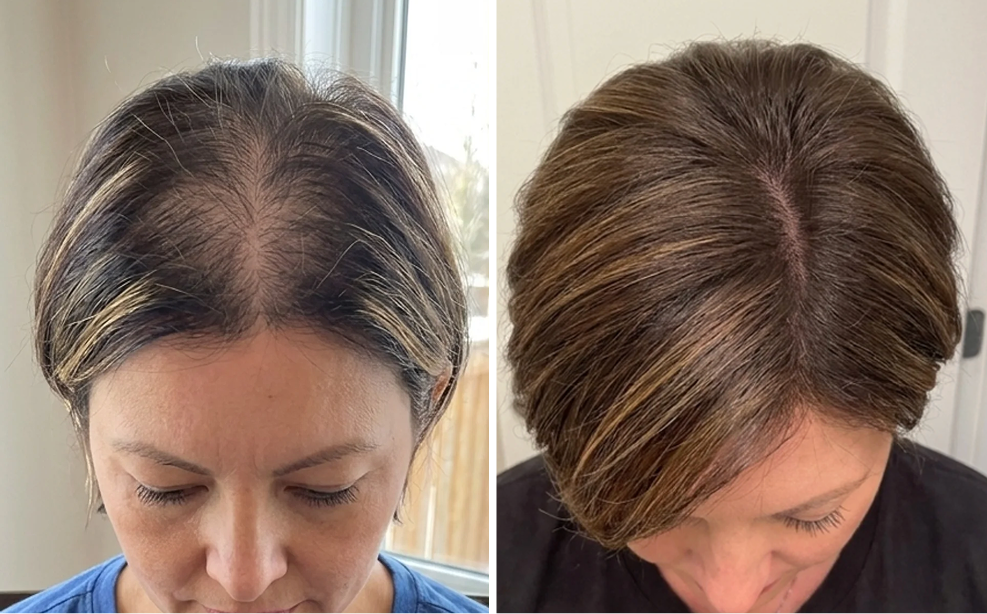
True hair loss usually looks less like a sudden pile of hair and more like a gradual change in density. You may notice:
- a widening part
- a thinner ponytail circumference
- more scalp showing at the crown
- recession at the temples
- patchy bare spots
- hair that grows back finer than before
If shedding is about how much hair is coming out, hair loss is about what is no longer filling back in.
How the hair growth cycle explains shedding and loss
The hair cycle helps explain why some hair in the shower is normal and why ongoing thinning is different. Hair grows in repeating phases, and each follicle is on its own schedule.
Here is the cycle in plain English:
- Anagen: the growth phase, when a hair actively grows
- Catagen: a short transition phase
- Telogen: the resting phase
- Exogen: the shedding phase, when the old hair releases
Normal shedding happens at the end of this cycle. Hair loss often happens when the growth phase gets shorter, fewer hairs stay in anagen long enough, or follicles miniaturize and produce thinner strands.
A helpful shorthand:
- Shedding = more hairs entering exogen at once
- Hair loss = less healthy regrowth over time
Why am I losing so much hair female: common reasons women notice more shedding
Women often notice sudden shedding after a trigger that happened 2 to 3 months earlier. This pattern is common in telogen effluvium (TE), a type of diffuse shedding where more hairs shift into the resting and shedding phases at the same time.
Common triggers include:
- postpartum hormonal changes
- major stress
- fever or illness
- COVID or other infections
- surgery
- crash dieting or rapid weight loss
- medication changes
- low iron or low ferritin
- thyroid imbalance
- perimenopause or menopause
This is why the right question is often not "Why is my hair falling out today?" but "What changed a few months ago?"
Why pattern hair loss behaves differently from temporary shedding
Androgenetic alopecia (AGA), also called pattern hair loss, usually causes gradual thinning rather than a sudden surge of hair fall. In men, it often shows up at the temples and crown. In women, it more often appears as diffuse thinning across the top of the scalp with a widening part.
DHT (dihydrotestosterone), a hormone derived from testosterone, is one of the main drivers. In people who are genetically sensitive to it, DHT contributes to follicle miniaturization. That means hairs grow back finer, shorter, and less visible with each cycle.
So while temporary shedding often feels sudden, pattern hair loss usually feels slow, persistent, and harder to pinpoint to one event.
How to tell if you are shedding hair or actually losing hair
The simplest way to tell is to look at pattern, timing, and density. Shedding usually spikes after a trigger and may leave overall density looking fairly stable at first. Hair loss usually shows up as a visible reduction in fullness over weeks, months, or years.
| Clue | More likely shedding | More likely hair loss |
|---|---|---|
| Timing | Sudden increase after stress, illness, childbirth, surgery | Slow progression over months or years |
| Where you notice it | Shower, pillow, brush, clothing | Wider part, crown, temples, scalp visibility |
| Density change | May look normal early on | Fullness clearly decreases over time |
| Pattern | Often diffuse all over | Often patterned or concentrated |
| Regrowth | New hairs often return once trigger resolves | Regrowth may be slower, finer, or incomplete |
| Hair strand | Full-length hair with club bulb | Miniaturized finer hairs may be present |
Signs it is more likely hair shedding
It is more likely shedding if you notice:
- a sudden increase in hair on your pillow or in the shower
- more strands on clothing or the bathroom floor
- a recent trigger 2 to 3 months earlier
- diffuse loss from all over rather than one area
- no major change in part width right away
This pattern often fits telogen effluvium. It can feel dramatic, but it does not always mean permanent loss.
Signs it is more likely hair loss
It is more likely hair loss if you notice:
- a widening center part
- more scalp showing under overhead light
- a shrinking ponytail
- thinning at the crown
- receding temples or hairline changes
- patchy areas
- thinning that has continued for months or years
This pattern deserves closer attention, especially if there is a family history of pattern thinning.
When breakage is the real issue
Sometimes the issue is not shedding from the root at all. It is breakage along the hair shaft.
Broken hairs are often:
- shorter than the rest of your hair
- uneven in length
- missing the white club bulb at one end
- concentrated around areas exposed to heat, bleach, relaxers, or tight styling
If your ends look frayed and your strands are snapping, the problem may be damage rather than scalp-level shedding.
What causes excessive hair shedding and what causes hair loss?
Excessive shedding and true hair loss can overlap, but they are not the same process. Telogen effluvium is one of the most common causes of sudden diffuse shedding. Androgenetic alopecia is the most common cause of gradual long-term thinning.
Other causes can be medically relevant and should not be guessed at from search results alone.
Common causes of hair shedding
- stress
- high fever
- COVID or other illness
- childbirth
- surgery
- rapid weight loss
- medication changes
- low ferritin
- short-term hormonal shifts
These triggers can push more follicles into telogen at the same time. The shedding usually appears later, not immediately.
Common causes of hair loss
- pattern hair loss in women and men
- autoimmune conditions such as alopecia areata
- traction alopecia from tight hairstyles
- chronic inflammation affecting the scalp
- thyroid disease
- nutrient deficiencies
- PCOS (polycystic ovary syndrome) in some women
- long-standing DHT-related miniaturization
Some forms are temporary. Some are progressive. That is why the pattern matters.
When sudden shedding needs a medical workup
Sudden, heavy, or persistent shedding can justify a medical workup, especially if you also have fatigue, cycle changes, weight changes, scalp symptoms, or other signs something systemic may be going on.
A clinician may consider labs such as:
- ferritin
- thyroid function
- vitamin D
- vitamin B12
- iron studies
- other hormone or inflammation markers based on symptoms
Can you stop hair shedding immediately? What actually helps and what to expect
No, you usually cannot stop hair shedding immediately. Hair responds on a biological timeline measured in weeks to months, not overnight.
That is frustrating, but it is also why miracle claims in this category should be treated carefully. Once follicles have shifted into the shedding phase, the process usually has to run its course. What helps most is identifying the trigger, correcting what is correctable, and giving regrowth enough time.
Hair shedding treatment: what may help if shedding is temporary
If shedding is temporary, support usually starts with the trigger. That may mean:
- recovering after illness or surgery
- correcting nutrient deficiencies
- improving calorie and protein intake after restrictive dieting
- reducing physical and emotional stress where possible
- using gentler hair care
- avoiding tight styles and excessive heat
For many cases of telogen effluvium, the best treatment is a combination of patience and fixing what pushed the follicles out of rhythm in the first place.
What may help if it is true hair loss
If it is true hair loss, a broader plan may make more sense. Options can include:
- dermatologist evaluation
- topical minoxidil
- prescription treatments for some patients
- oral supplements when nutritional or systemic support is relevant
- procedural options for advanced cases
An oral supplement can be a reasonable part of that plan when stress, inflammation, nutrition, and hormonal pathways may all be contributing. The Root Co. Hair Growth Vitamins are positioned around that multi-factor idea. The formula is built to address four causes of hair loss at once: DHT activity, nutritional gaps, scalp inflammation, and stress damage. It includes eight confirmed actives and is taken as 2 capsules daily, one with breakfast and one with dinner.
The product is not a diagnosis, and it is not a substitute for medical treatment when hair loss is patchy, inflammatory, or advanced. But it may be worth considering for early to moderate thinning, stress-related shedding support, or hormonal thinning when a systemic approach makes sense. The brand's differentiators include US Patent , a clinical reference presented to the International Society of Hair Restoration Surgeons, and a 30-day money-back guarantee. You can review the brand's Hair Growth Vitamins formula if you want the full ingredient list and product details.
Realistic timelines for improvement
| Situation | What to expect |
|---|---|
| Temporary shedding after a trigger | Shedding may settle over 2 to 3 months once the trigger is addressed |
| Early signs of regrowth | Baby hairs or reduced shedding may appear over the next few months |
| Pattern hair loss treatment response | Visible thickening often takes 3 to 6 months or longer |
| Long-standing thinning | Improvement is usually slower and may need combination treatment |
Hair grows on a slow clock. That is true whether you are recovering from telogen effluvium or treating pattern thinning.
When to see a dermatologist and how to choose the right next step
You should consider seeing a dermatologist if the pattern looks unusual, severe, or persistent. Patchy hair loss, scalp symptoms, or thinning that continues beyond 3 to 6 months deserves a closer look.
A good next step depends on whether you need monitoring, medical evaluation, or supportive care.
See a dermatologist sooner if you have:
- patchy bald spots
- scalp pain, itching, or scaling
- sudden severe shedding
- signs of hormonal imbalance
- shedding that does not improve
- thinning that keeps progressing
- concern about scarring alopecia or autoimmune loss
Questions to ask before starting any hair shedding treatment
Before starting treatment, ask:
- What changed 2 to 3 months ago?
- Is the shedding diffuse or patterned?
- Do I also have fatigue, weight change, cycle changes, or acne?
- Is there a family history of pattern hair loss?
- Am I seeing full-length shed hairs or broken hairs?
- Has my part widened or my ponytail shrunk?
These questions help separate temporary shedding from a longer-term issue.
What an oral supplement can and cannot do
An oral supplement may support hair health when stress, nutrition, inflammation, or hormonal pathways are contributing. It cannot diagnose thyroid disease, autoimmune conditions, or PCOS, and it cannot restore follicles that are permanently lost.
That boundary matters. Supplements work best when follicles are still active and when there is something meaningful to support systemically. If an area has been completely bald for years, or if loss is sudden and patchy, get a medical evaluation first.
If you are pregnant, nursing, taking prescription medication, or experiencing sudden or significant hair loss, consult your healthcare provider before adding a new supplement to your routine. Sudden hair loss can sometimes be a sign of an underlying condition worth investigating.
These statements have not been evaluated by the Food and Drug Administration. This product is not intended to diagnose, treat, cure, or prevent any disease.
FAQ
How do I know if my hair is shedding or if I am losing hair?
If the increase is sudden, diffuse, and linked to a trigger from 2 to 3 months ago, it is more likely shedding. If your part is widening, your ponytail is shrinking, or your density has been declining over time, it is more likely hair loss.
What does 100 hairs look like when you shed in a day?
About 100 hairs can look like a surprisingly large clump, especially if your hair is long. It may show up in the shower, on your brush, and on your pillow across the day without automatically meaning something is wrong.
Why am I losing so much hair female all of a sudden?
Sudden shedding in women often follows postpartum hormone shifts, stress, illness, surgery, crash dieting, medication changes, low ferritin, or thyroid issues. The event that triggered it often happened a few months earlier.
Can hair shedding turn into hair loss?
Yes, sometimes. A person can have temporary shedding and underlying pattern hair loss at the same time. For example, telogen effluvium can reveal androgenetic alopecia that was already developing underneath.
Can you stop hair shedding immediately?
No. Safe treatment does not stop shedding instantly because hair moves through a cycle measured in weeks to months. The goal is to address the cause and support recovery, not force an overnight change.
When should I see a dermatologist for hair shedding or hair loss?
See a dermatologist if you have patchy loss, scalp pain or itching, severe sudden shedding, symptoms of hormonal imbalance, or thinning that continues beyond 3 to 6 months.
Read more

Learn how much hair shedding is normal per day, what 100 hairs looks like, and when shedding may signal hair loss or a reason to see a doctor.
Learn when a supplement for hair regrowth can help, which ingredients matter, realistic timelines, and how options like The Root Co., Nutrafol, and Viviscal compare.